

Come to Call
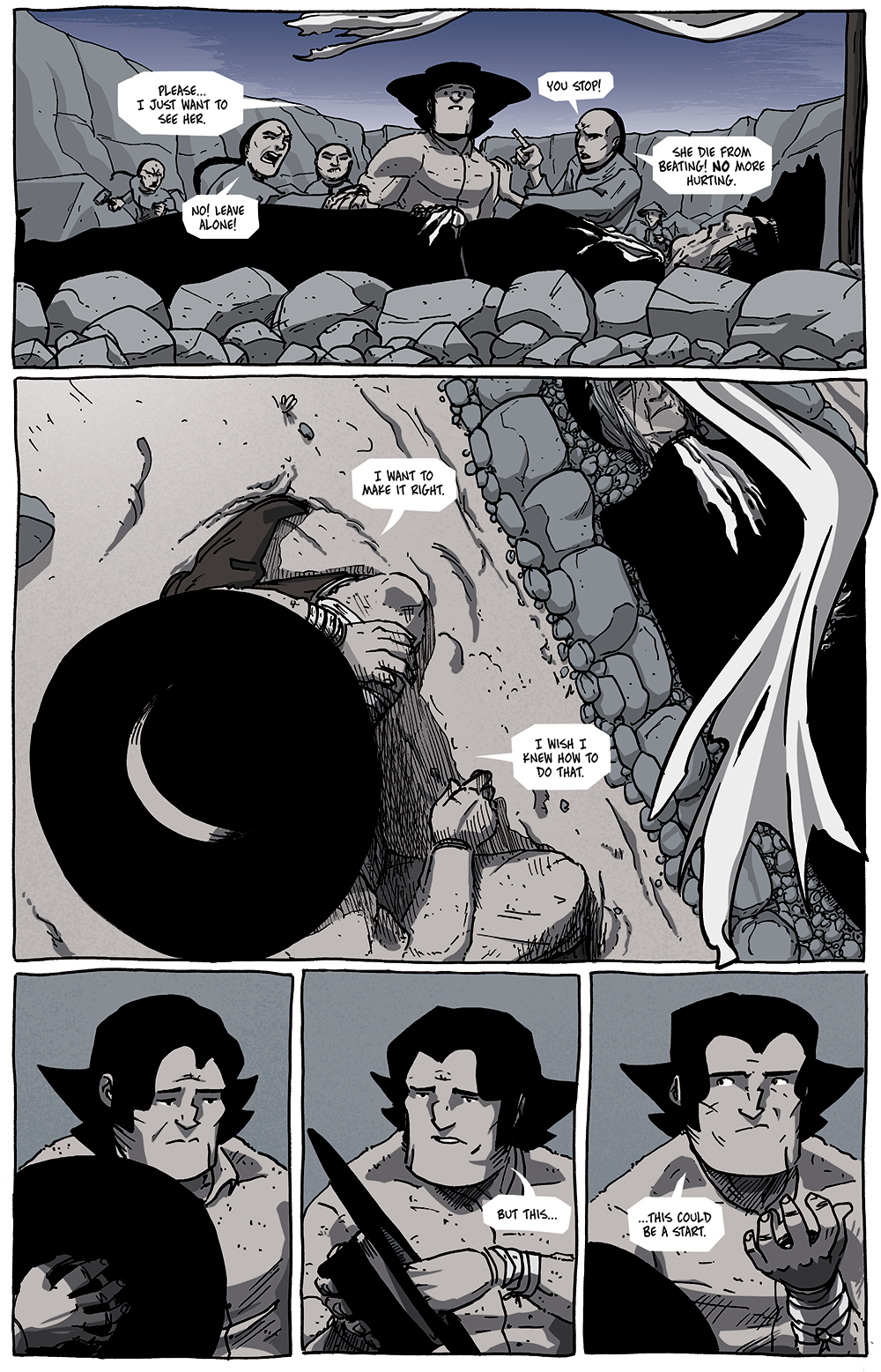
The transitional element of the white banner here, blending from the long white cloth hanging from Hellrider John’s mask into the cloth that is tied to the oar above Jackie’s resting place, is an example of finding a historical detail and running with it.
As is revealed in the Hellrider Jackie short story, “The Patient Feast” (exclusively available in the volume 4 book and ebook), when Jackie attacks Rich Jack’s attempts to build a railroad line through Mono Basin, right by Mono Lake, she only kills the white workers and absconds the Chinese laborers away to the big island in Mono Lake, Paoha Island. When they learn of her death, they bring her body back to the island to lay her to rest, flying a white banner memorializing her.
While writing this scene, I wondered what the Chinese funeral rites were at the time, especially for those who immigrated to the states in the late 19th century. What helped the most was an amazing The Journal of American Folklore (vol. 113, no. 450, 2000) article by Linda Sun Crowder called, “Chines Funerals in San Francisco Chinatown: American Chinese Expressions in Mortuary Ritual Performance” which described the laying of a long white cloth or blanket on the casket of the deceased (456), and the use of white banners was further supported by the excerpts I could find of what seems like a fascinating book called Chinese American Death Rituals: Respecting the Ancestors (Eds. Sue Fawn Chung and Priscilla Wegars).
Learning about the cultural traditions around death and the stark beauty of the imagery created by a white banner, I couldn’t help but incorporate it into the comic.
Furthermore, the story of Chinese workers being hidden away on Paoha Island is indeed a real story, though no Hellrider was involved, obviously. As described by Marguerite Sprague in her incredible book (and invaluable source during the entirety of Long John‘s creation), Bodie’s Gold: Tall Tales & True History From a California Mining Town, when the Standard Mine in Bodie was building its railroad, white workers got upset with how many Chinese workers they saw at the site and they demanded Standard Mine to fire all the Chinese workers and hire only white workers, which the owners balked at and kept doing things their way:
A group of about 40 “excited individuals” (who were white) headed angrily for the worksite (Daily Free Press 25, 27 May 1881). Luckily for the workers themselves, word preceded them and the men overseeing the railroad project hastily gathered up the Chinese workforce and took them to Paoha Island in Mono Lake…There they camped out with thirty days of rations and waited. (Sprague 115)
I read that early in the development of Long John (in fact, reading that book was one of the main inspirations for moving forward with Long John), but it’s an anecdote too hyperbolic and dramatic to not want to include in the story, so I gave it to Hellrider Jackie who did the same but for more mysterious (and maybe noble?) purposes.
Thumbnail for this page. Click for larger version.
Discussion ¬