
• Newest Comic
  • About
    • Synopsis
    • Characters
    • Author
    • F.A.Q.
  • Archive
    • Comic Archive
    • Blog Archive
  • Links
    • Press
    • Connect
    • D. Bethel’s Work
    • Contact
    • Friends of Long John
  • Shop
    • Online Store
    • E-Books
  • YouTube

Long John

Losing Every Thing Changes Everything

Part of the Plan: Kyrun Silva

Mar20
by DBethel on 20 March 2017
http://www.longjohncomic.com/audio/PotP01.mp3

Podcast: Play in new window | Download

Part of the Plan is a proposed interview series about process where D. Bethel talks to creative people of all media about how they make their work. It’s an investigation into the process of creativity that threads together the spectrum of all creative people from popular culture to strict academia. It’s a celebration and critical investigation into how people make stuff.

Shaman’s Destiny creator, Kyrun Silva, loves comics absolutely. I’ve said it before, but with as cynical as I can get, especially with superhero comics, Kyrun can show up and all of a sudden, I’m talking about ’90s X-Men and early Image Comics work (like WildC.A.T.s, Deathblow, Youngblood, and Spawn) with as much vigor as I had when I was neck-deep in it as a teenager. Kyrun is able to bring any of your latent fandom out and elevates your current fandom to new heights, his passion for the form is infectious and toxic (in a good way). By the time we finished the hour-long session to record his interview, I was well and ready to record another hour solely talking about ’90s comics (and we’ll get to it eventually, but probably for my weekly nerd discussion podcast).
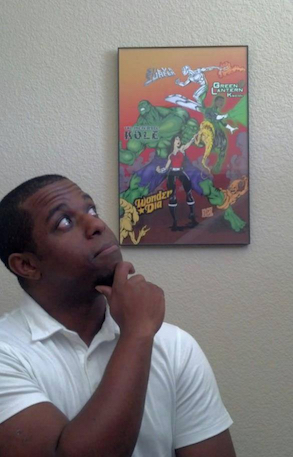
Kyrun Silva. Creator of Shaman’s Destiny and founder of Big Tree Comics.

His book, Shaman’s Destiny, is Kyrun’s spin on the format and stories he has loved since he was a child, and the passion breaks through in the layouts and art of the book. There’s a deep reverence for the characters and the story they play a part in. It is almost a metanarrative––it’s like these characters know they’re in a comic and wholly respect the job they’ve been tasked to do and do so in as epic a style as possible.

It’s funny that Rob Liefeld is Kyrun’s favorite artist because Liefeld is the person of whom Kyrun reminds me the most. Say what you want about Liefeld––and I’ve certainly said things––the dude is not only one of the most famous (and infamous) comic creators of all time, but through all of his years writing and drawing comics and all the ups and downs he has experienced, Liefeld is still a super fan. He loves comics and even if you have nothing but vitriol for his art and business practices, to a point where you actually have personal feelings about him as a person, I dare you to watch an interview with Liefeld and smile. He loves comics and is still so exhaustingly jazzed about them. So pumped is he about the medium that your fires naturally get stoked, too. Kyrun has that same energy and passion and it’s fantastic to be around. If there’s anything I learned about how Kyrun makes comics during the talk I had about the process with him, is that he trusts that passion and love for the medium and it guides his hand from pencil to ink to print.
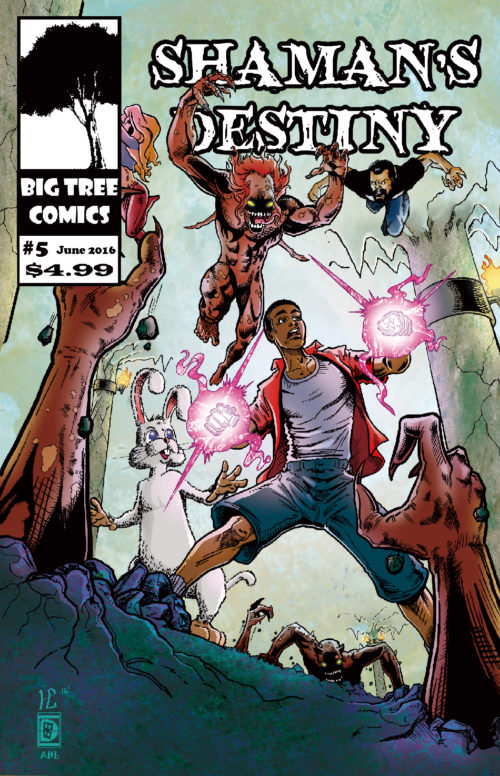
Cover for Shaman’s Destiny #5. Art by Kyrun Silva and Michael Dorman. Check out the Kickstarter campaign to collect the series as a trade paperback collection.

Be sure to check out his Kickstarter campaign to collect all six issues of Shaman’s Destiny in to a trade paperback collection (I think I have a pinup of the main character, Malik, in issue #5) at btcreates.com before it ends on March 31. A pledge of $20 gets you a physical copy of the trade itself.

Thanks again to Kyrun for letting me test out this idea on him. If more Part of the Plan interviews get made, the structure may change and bend as I figure out exactly what I want it to be, but even in this primordial stage a lot of good stuff came out of the conversation and I couldn’t have had a better first subject for this potential series. Once I get my bearings to the point where I can have fun conversation and probe even deeper into interesting thoughts and issues, I’d love to bring Kyrun back for a round 2 (and, ultimately, that talk about ’90s comics!).
2 Comments

Mind in the Gutters – Katsuhiro Otomo’s Akira

Feb21
by DBethel on 21 February 2017
http://www.longjohncomic.com/audio/Gutters03a.mp3

Podcast: Play in new window | Download

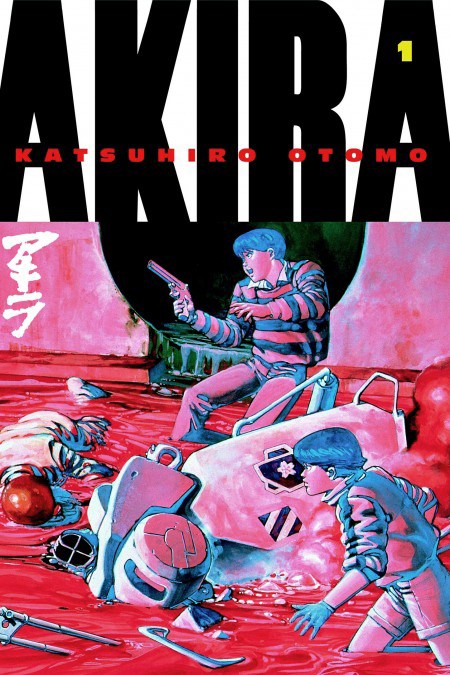
Akira, as an anime and manga series, is arguably better known for being a groundbreaking work than for the story it tells (variable as that may be, depending on the medium). From presentation to content to technology and themes, Akira has earned a place in the cultural discourse of not only Japan but the rest of the world as well.

As I mentioned on my nerd culture podcast, I have come to Katsuhiro Otomo‘s manga after having seen the anime, which I’m sure is the course most westerners took since the movie was such a significant event, especially in the nerd world. Even when I was only three volumes into the story, I already saw a significant diversion in narrative between the manga and anime, to the point that the movie feels less like an adaptation and like a new story using the same players. This difference intrigued me to the point that I found myself down the hole of an academic database search for any criticism about Akira.

Not surprisingly, the discourse around both the anime and manga nearly unanimously focuses around its use of imagery related to nuclear weapons and Japan’s historical tie to them. While not wrong nor an insignificant approach to the work, I feel that using a small lens on such a large work misses out on a lot of fantastic critical angles. Also, when conversations around Akira happen in person (with friends or fellow fans) and the group wants to take it to serious territory, it seems the only road to travel is the one that leads to nuclear warfare and its relation to Japanese history as well.

↓ Read the rest of this entry…

 Comment 

Amano Remembers

Jan11
by DBethel on 11 January 2017

Japanese illustrator Yoshitaka Amano has had a subdued but constant presence on this site, but I don’t think I could ever downplay his importance on me. If his style hasn’t exactly been as influential on mine, his ethic and persona have been. In every interview I’ve read (albeit translated) from him, I have always been impressed by how grounded and practical Amano is in light of being a painter of fantasy with such an ethereal and imaginative style.

I know him––and most nerds probably know him––from his work on the Final Fantasy franchise of video games. He is the only member of the production who has been involved in every single iteration since the beginning, though how integral he was to development has varied over the years. Needless to say, he has become the spine of the book that is everything Final Fantasy, and as we approach, surprisingly, the 20th anniversary of the release of Final Fantasy VII––arguably the first game where he moved from the artistic front seat to the back, ironically––he is being celebrated along with everybody else that worked on the game.

The video game news website, Polygon, has put together a rather wonderful oral history of Final Fantasy VII, and included among the contributors is Amano himself, along with a video of him drawing as he talks about his input on the game. Its’ an amusing video for a few reasons. Again, it was the first game in the series that he wasn’t the primary character designer on (for a variety of reasons), so his involvement is a bit more understated than other members of the staff. Second, what really comes through is how much of a job this was.

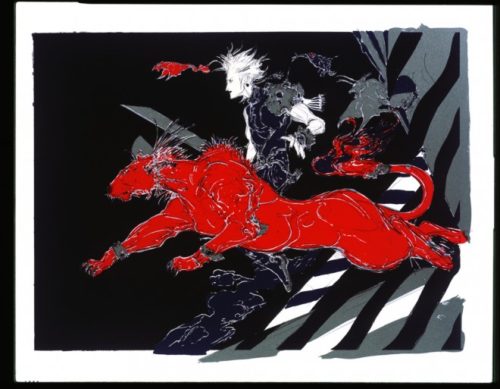
“Matataki (An Instant)” by Yoshitaka Amano for Final Fantasy VII

Final Fantasy VII was the launchpad that took the series from being the jewel in the crown of home video game console role-playing games (specifically, Japanese Role-Playing Games, or JRPGs) and made it into an industry-wide sensation. But even then, what’s clear is that for most of those who worked on this game, like most games, was more a work of pure effort and talent than the artistic expression that we tend to want to attach to nostalgia.

I first saw this dissonance between art and artists when cartoons from the 1980s were becoming popular again as those who were children then became adults with disposable income (I raise my hand here). Documentaries about The Transformers, let’s say, were included on DVD boxed sets of seasons with interviews with the writers and voice actors and when asked questions akin to “What were you thinking when you worked on this cartoon from thirty years ago? What were you trying to say?” the answers are always the same, “It was a paycheck and I had rent to pay.”

They had no idea how important these cartoons would eventually be to the children who were watching and I’m sure, especially for the Japanese game development industry, many who worked on the games of our youths feel much the same way. I’m so pleased that most of those involved with things I loved as a kid are around to receive the adulations and praise they so very much deserve, because it’s safe to say that people like Yoshitaka Amano and his colleagues are responsible for those making great work today.

 Comment 
  • Page 84 of 112
  • « First
  • «
  • 82
  • 83
  • 84
  • 85
  • 86
  • »
  • Last »
  • Instagram
  • Facebook
  • YouTube
Privacy & Cookies: This site uses cookies. By continuing to use this website, you agree to their use.

To find out more, including how to control cookies, see here: Cookie Policy
  • Newest Comic
  • About
  • Archive
  • Links
  • Shop
  • YouTube

©2014-2026 D. Bethel | Powered by WordPress with ComicPress | Subscribe: RSS | Back to Top ↑