• Newest Comic
  • About
    • Synopsis
    • Characters
    • Author
    • F.A.Q.
  • Archive
    • Comic Archive
    • Blog Archive
  • Links
    • Press
    • Connect
    • D. Bethel’s Work
    • Contact
    • Friends of Long John
  • Shop
    • Online Store
    • E-Books
  • YouTube

Long John

Losing Every Thing Changes Everything

Sketch Fridays #46 – Mark “The Animal” Mendoza

Sep01
by DBethel on 1 September 2017

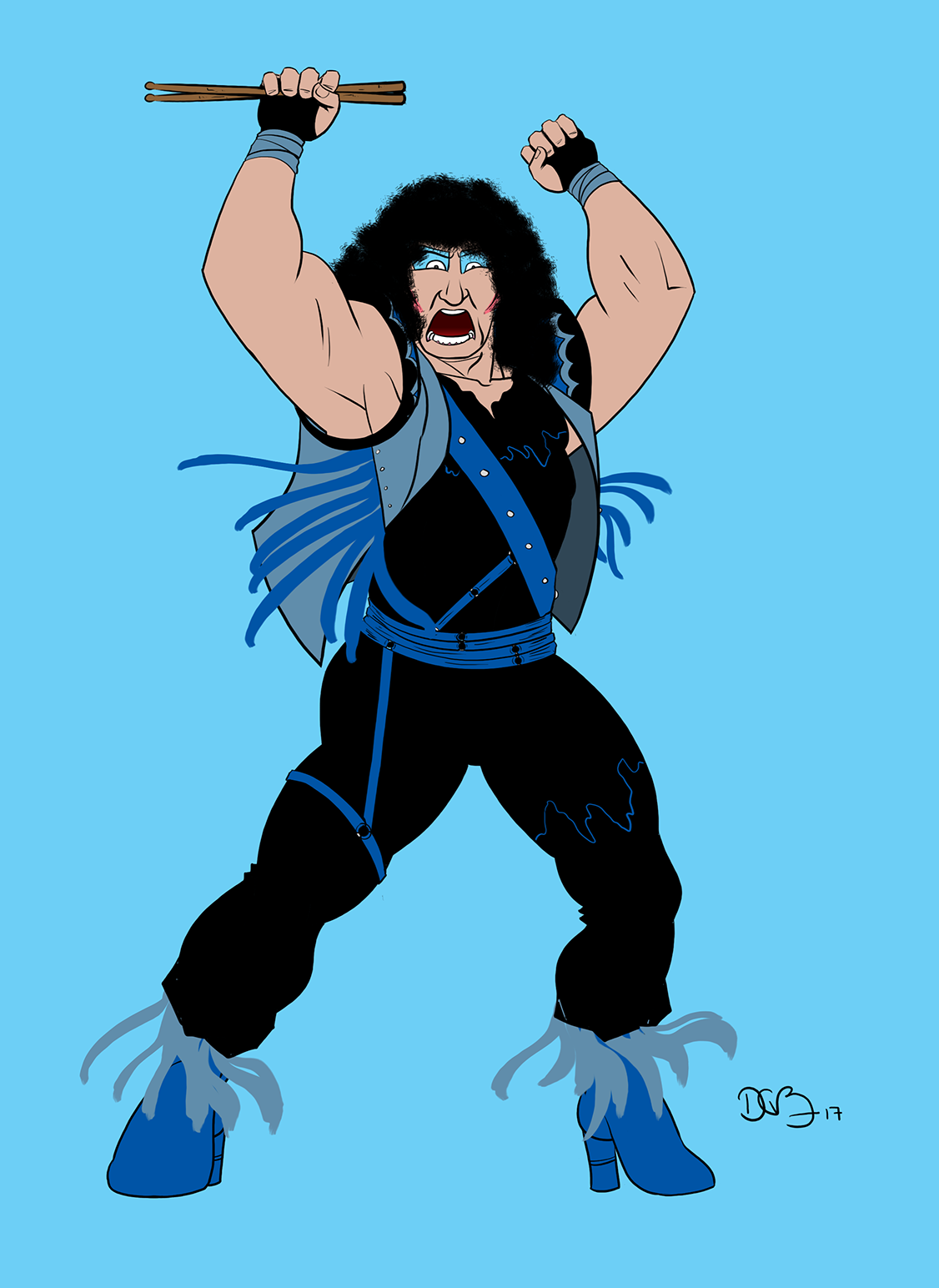
Sketch Fridays #46 – Mark “The Animal” Mendoza (bass guitar/backing growls/producer)

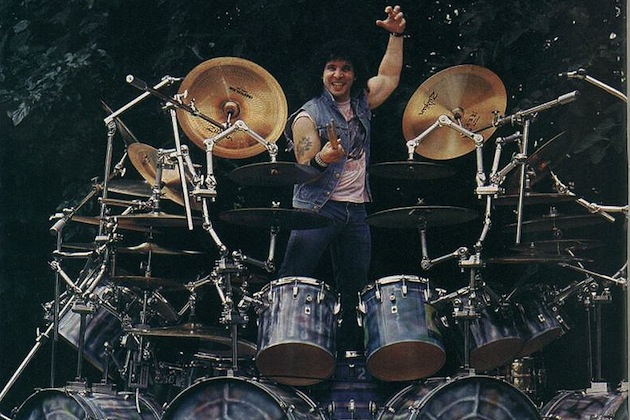
Mark “The Animal” Mendoza, along with drummer AJ Pero, make up the rhythm section of Twisted Sister and despite the fact that the word “powerful” could be used to describe both of them, what it represents for each couldn’t be more different. To fully understand what The Animal adds to the band, you’d have to watch a video of the band performing, because it’s clear ten seconds into any song that Mendoza is raw power. Ferocious power. When big open bass notes need to sound, he literally punches his bass (not in a slap bass kind of way, like in a bar fight kind of way). At other times, he grabs the mic stand in front of him and slams it into the neck of his bass. Even when dramatic flair isn’t needed, and he’s just idling on the root notes of the chord progressions, his right hand never sits still, instead drawing back like a baseball swing before hitting each note again. He does all of this while standing gigantic to the right of the stage, his mouth hanging open in a growl, as if it were just another part of the music, you just can’t hear it over the din of the band.

The Animal is ferocious in makeup and out of it.

The band is always pretty self-effacing about their musicality. They’ve used words like “simple” or “primal” or, occasionally, “dumb” to describe the music that they make. While their songs aren’t complex, it’s also pretty public that they never wanted their music to be that progressive. Despite their urgent pursuit of success (carefully outlined in a fantastic documentary titled We Are Twisted F***ing Sister) and their eventual attainment of it, their time as a bar band clearly and fully shaped how they play live and how they write songs. The band wants songs that get the audience to jump in time, to pump their fists in the air to every downbeat. The last thing they want any member of an audience to do is ponder during a set.

With templates established by the likes of Alice Cooper, AC/DC, and Slade, Twisted Sister found their mode and fully owned it.

With that in mind, this band was likely the first time I ever really heard the bass in the mix of the song. Since they often let power chords ring out, the drums and the bass have to work hard to keep the songs stomping forward, and there are a few songs where the bass is given prominent placement or chances to do quick, standout fills that really add a unique quality to what could be otherwise standard––but effective––rock songs.

https://youtu.be/ALZrvJF2JQA

It’s a testament to a guiding ethic. Sure, as a band they probably could have taken an album to do a musically complex and divergent concept piece, but they, as a group, made a decision about what this thing called “Twisted Sister” should be and they stuck to it. It’s inspiring because when working with an ethos it, I would argue, actually promotes creativity and stability rather than stifling it. A creative space without parameters, I find, is actually limiting because full freedom is overwhelming for the mind to handle. It’s easier to make something when you know what tools are available rather than having every tool available for any project. Though very different music, this is what The White Stripes did––giving themselves severe restrictions technologically (in their case), among other requirements, with which Jack and Meg White had to create new album.

In a sense, it’s also a bit of how I approach Long John. There are a few rules I have set for myself that I plan to never break, or, if I do, they will be for an important and rare narrative purpose. First is the technology; All of the interior, narrative pages of Long John will be drawn by hand. No digital should be present aside from the coloring and lettering. For the first chapter, I followed an aesthetic rule to try and always have Long John framed between two strong parallel lines to emphasize the fact that he’s trapped by his old mentality and he needs to break free from it in order to grow. You will never see Long John in his old clothes. These rules, though arbitrary, actually enhance the process for me. If they aren’t strictly improving the art, they are helping to keep my attention and to avoid falling into a nigh muscle memory pattern of creation that allows me to draw just fine but not think too hard about it. I wanted to stay focused and creative while drawing every frame of Long John, and it’s these rules that not only do so, but, because of that, results in a better product, I would argue.

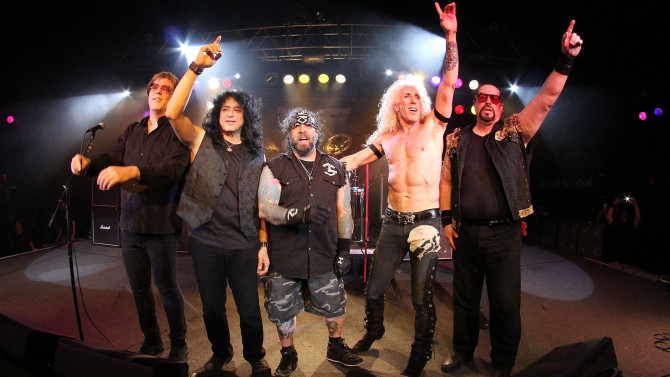
I can’t say I got the idea to impose such rules on myself from Twisted Sister, but their example was there and known to me, and what impressed me is that it is clear, in hindsight at least, that this work ethic is something the entire band values and respects. The best evidence of this is when the band reunited after fifteen years apart. Sure, they looked different and even sounded a little different, but when the stage lights turned on it was clear they knew exactly what to do even all these years later. Watch a live show from 1984, 2004, or 2014; all of them are imposing displays of power, never compromising and never not Twisted Sister.

The Animal still has teeth.

2 Comments

Sketch Fridays #45 – Eddie “Fingers” Ojeda

Aug25
by DBethel on 25 August 2017

Sketch Fridays #45 – Eddie “Fingers” Ojeda (lead guitarist, backing vocals)

Most people know Twisted Sister’s biggest hit, “We’re Not Gonna Take It,” which is probably one of the only heavy metal hits written in a major key, and while that song is fine, the band (as any fan of any band would say) has so much more substance than that song shows. By the time that song hit the airwaves, the band had been around for eight years already and had been regionally successful, selling out arenas in the tri-state area to thousands of people. Their success with Stay Hungry‘s lead single, “We’re Not Gonna Take It,” in hindsight, acted more as the icing on the cake that had spent nearly ten years baking.

In fairness, “We’re Not Gonna Take It” is a good encapsulation of what the band stood for in a way that appeals to as broad an audience as possible––they didn’t compromise anything about themselves with that song––and part of a look through their catalogue shows that their biggest hit was the result of an evolution rather than a lucky strike while the iron was hot. Jay Jay French once described the band as what you would get if Alice Cooper were blended with British rockers, Slade (the originators of the song, “Cum On Feel The Noize,” which would later be covered by Quiet Riot), and it is in the latter that I think Twisted Sister, and specifically Dee Snider’s songwriting motivation, owes more than even the band wants to let on.

https://youtu.be/Qu_ozjAu_vM

Slade’s “Cum On Feel The Noize” and its predecessor, “Mama, Weer All Crazee Now”, are raucous party songs that culminate in a crowd singing along, a crowd much larger than what can be comprised of just the band itself. In an interview with Slade’s lead singer, Noddy Holder, he said that it was an attempt to capture the feel and sound of a live show on a record. This anthemic, participatory sound and structure is at the heart of Dee Snider’s songwriting, starting in the late seventies where we can not only hear the influence of Slade’s aesthetic and groundbreaking recording choices (and, perhaps, their choices of clothing) but also the seeds for what would become “We’re Not Gonna Take It.”

https://youtu.be/whJRCGSDjEs

If this connection were solely because Twisted Sister and lead songwriter, Dee Snider, were fans of Slade, it would make sense, but the connection is even stronger when one considers that Twisted is generally considered to be a premier live band. They ran high-energy shows, right up until they called it quits at the end of 2016 (marking Dee’s 40th year with the band) and a highlight of their shows, as can be heard in the plethora of recordings, is how interactive the band and Dee is with the audience. From the call-and-response, Slade-ish type of choruses to Dee’s “raps” with the audience, which could be lengthy monologues in their own right, audience participation was a key element to the band’s image as well as its success, and every time Dee swung for a big hit, it always included that element, especially in the codas when the songs idled on what sounded like a mob chanting the chorus while Dee improvised over them.

With each album, a version (though not literally) of what would become “We’re Not Gonna Take It” exists; from the earliest attempt with “I’ll Never Grow Up Now” in which Dee is barely recognizable to the club hit, “Bad Boys of Rock and Roll”, it’s clear that Dee has a tone he’s going for and that it’s very much a cry for an entire demographic rather than just of a band as both songs proudly devolve into chanting, riffing, but controlled, chaos. With their first major label release, the band finds a focused and largely successful iteration in “I Am (I’m Me)” which proved to be a mild hit overseas. Again, though, the structure is clear, continuing in a straight line all the way from Slade.


Once “We’re Not Gonna Take It” landed (along with the second single from the Stay Hungry album, “I Wanna Rock”), Twisted’s follow-up album, Come Out and Play, didn’t really have an analogue, which I feel is to the band’s credit. With their fame and success, they decided to go bigger and more melodramatic with the opener and title track (which I like very much). It wasn’t until their final album, Love Is For Suckers, that Dee returned to the well one last time, but the take was decidedly different––more tired and wizened, but no less ferocious. That track, “Wake Up (The Sleeping Giant)”, stands in stark contrast to the rest of the album and honestly feels like one of the few “genuine” Twisted Sister tracks from it, even quoting from their previous hit when Dee cries out in a pre-chorus build-up: “We took all we’re gonna take.” It’s focused and profound but it falters in that it is a singular song, lacking the party-like atmosphere of “We’re Not Gonna Take It” and its antecedents, moving away from being more inclusive to being more militaristic. As an angry teen, “Wake Up” was the song from this lineage that I liked the most and still gives me chills when I listen to it today.

Why it was that “We’re Not Gonna Take It” was the one that broke through, I’m not sure. Its chorus was a finely honed chant that anybody could sing with a sentiment anybody could get behind. The cynical answer would be that with all the attempts at the formula, one would eventually stick with a larger audience. Part of it, if we’re to talk musically, surely has to do with its melody. As mentioned earlier, despite its anarchic lyrics, the major key in which it’s written lends an air of, for lack of a better word, patriotic or, at the very least, empowering attitude. The driving melody, repeated ad nauseam to great effect, is echoed in the lead by guitarist, Eddie “Fingers” Ojeda, who, despite being a clever and capable lead player, sticks to the main melody for the solo break in the middle of the song. For me, as an amateur player, I wouldn’t be surprised if the band didn’t realize the song was written in a major key (it’s easy to miss these things) and they couldn’t figure out what a more traditional, minor key solo didn’t sound right. When in doubt, stick with what works, and it’s hard to ignore the power of that melody and affixing that to the guitar solo only makes the song feel more like a grand anthem than just another rock song. If anything, I feel it is more of a vindication and validation of Slade––who never really broke through in the States––than Quiet Riot’s begrudging cover ever was. For Quiet Riot, “Cum On Feel The Noize” was a single shoved upon them by management. For Twisted Sister, Slade and “Cum On Feel The Noize” was buried treasure that they invested in wisely and personally.

I bring these songs up because these are a big part of Twisted Sister’s oeuvre, but they’re the songs I have the least connection to. They’re fascinating and fun, but they’re more statements of purpose to the outside world, speaking for the people Twisted Sister represents rather than speaking to them. For a band (and genre) that, superficially, can be quite off-putting, these songs stand as evidence that the doors to “our” world was not closed but, in fact, wide open to anybody. While their powerful, simple music and garish clothing and makeup could be misinterpreted as a statement of “If you don’t look weird and scream loud then you don’t belong,” their actual message––and one that I thankfully found as I gathered their catalogue in my teens––was much more humanistic, bold, and important: “Be yourself.”

This week’s drawing of Fingers was actually kind of difficult. In a band full of personalities, from Dee’s gregariousness to Jay Jay’s general cool to Mark “The Animal” Mendoza’s brute force to AJ Pero’s silliness, I fear Eddie gets buried underneath them because, of all the members of the band, he comes across as the musician. To be fair, all the members are capable musicians, but it comes across that Eddie is the guy that just loves to play music. Not only is he humble enough to share lead guitar duties with Jay Jay, but he is the only consistent backing vocalist in the band, and it would be irresponsible of me to say that Dee alone is the voice of the band. If you took away Eddie’s backing vocals on all of Twisted Sister’s songs, the band would sound completely different. Where Dee was the attitude and Jay Jay was the smarts, Eddie was the passion that made this group a band.

2 Comments

Sketch Fridays #44 – Jay Jay French

Aug18
by DBethel on 18 August 2017

Sketch Fridays #44 – Jay Jay French (band founder, lead/rhythm guitars, backing vocals, brains of the operation).

I never saw what Twisted Sister looked like until I was on my third purchase of theirs (and the first CD of theirs I owned) called Big Hits and Nasty Cuts––a collection of live performances and some studio tracks that weren’t simply “We’re Not Gonna Take It” and “I Wanna Rock” from their breakthrough third album, Stay Hungry. I was searching for their catalogue at a time before the internet was widely available and CD versions of Twisted Sister’s albums weren’t widely available because, at the time (the mid ’90s), the world was trying to forget any band that wore makeup and had big hair. Before picking up Big Hits, I had found on cassette tape their fourth album and Stay Hungry follow-up, Come Out and Play, but the cassette copy didn’t have any band photos in the liner notes. A while passed before I ever actually saw what Twisted Sister looked like. Once I did, I was shocked and aghast. I found it very difficult to reconcile what I heard with what I saw, it took even longer to reconcile what I saw with my own taste.

On the LPs and CDs, every Twisted Sister album had two band photos: one in makeup, one without. This is the back of the Come Out and Play vinyl; my cassette copy didn’t even have this picture.

As a group and individually, they’re gross. They look like Garbage Pail Kids versions of the “pretty” glam metal bands that were the rage in the ’80s, but I didn’t know––because, again, when I started listening to them was almost a decade after they broke up––that their look was part of the point and what got me to not only to look past their grotesque appearance, but to accept and celebrate it. They were conscious martyrs for the recluses and weirdos.


That if the people who just wanted to be left alone were always going to be singled out, they would intentionally look ridiculous as a way to challenge that hierarchy and to take the first hit. The band exhibited this in 1982 when they appeared on the British tv musical performance show, The Tube, and Dee saw that the crowd wasn’t at an excitement level that he wanted them to be (while playing a high octane cover of The Rolling Stones’ “It’s Only Rock and Roll”), when he went so far as to take the makeup off on-stage just to make the more prudish and scoffing audience members feel better:

He turned their power against them which is their message in a nutshell. Subsequently, it was that appearance on The Tube that essentially got Twisted Sister signed to Atlantic Records.

For this week’s drawing of the coolest member of the band, founder Jay Jay French (whose aviator shades appeared to be permanently affixed to his face), I tried to capture his attitude as faithfully as possible and, especially to frame it against the gregariousness of the band’s front man, for their pairing, I would argue, was the bedrock of the band’s attitude. While looking at photos of the band, familiarizing myself with names and faces, it was clear that Dee was an icon and a hero in many ways, there was the calm cool of Jay Jay that Dee could never outshine, and I tried to capture at least part of that in the drawing.

It must be noted that the drawing is not a faithful recreation of any of Jay Jay’s outfits. As with Dee’s drawing last week, these are going to be, in a sense, my design of their classic outfits, combining elements from different outfits they wore throughout the years (though not all of them). The most important aspect of the drawing is actually his guitar, a “pinkburst” Les Paul (a play on the standard guitar finish, a blend from black to natural called “sunburst”). It’s an homage to Jay Jay’s more recent effort with The Pinkburst Project, a foundation started by Jay Jay that references the general color scheme of his band while also calling attention to uveitis, an eye disease that chronically afflicts his daughter.


3 Comments
  • Page 74 of 111
  • « First
  • «
  • 72
  • 73
  • 74
  • 75
  • 76
  • »
  • Last »
  • Instagram
  • Facebook
  • YouTube
Privacy & Cookies: This site uses cookies. By continuing to use this website, you agree to their use.

To find out more, including how to control cookies, see here: Cookie Policy
  • Newest Comic
  • About
  • Archive
  • Links
  • Shop
  • YouTube

©2014-2025 D. Bethel | Powered by WordPress with ComicPress | Subscribe: RSS | Back to Top ↑