• Newest Comic
  • About
    • Synopsis
    • Characters
    • Author
    • F.A.Q.
  • Archive
    • Comic Archive
    • Blog Archive
  • Links
    • Press
    • Connect
    • D. Bethel’s Work
    • Contact
    • Friends of Long John
  • Shop
    • Online Store
    • E-Books
  • YouTube

Long John

Losing Every Thing Changes Everything

Sketch Fridays #20 – Liefeldesque

Mar11
by DBethel on 11 March 2016
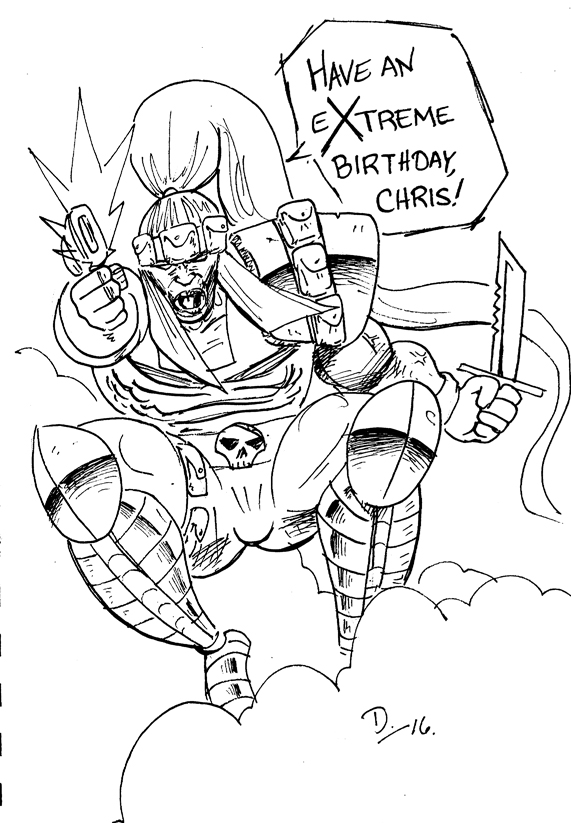
Sketch Fridays #20 - Liefeldesque. Click to enlarge.

Sketch Fridays #20 – Liefeldesque. Click to enlarge.

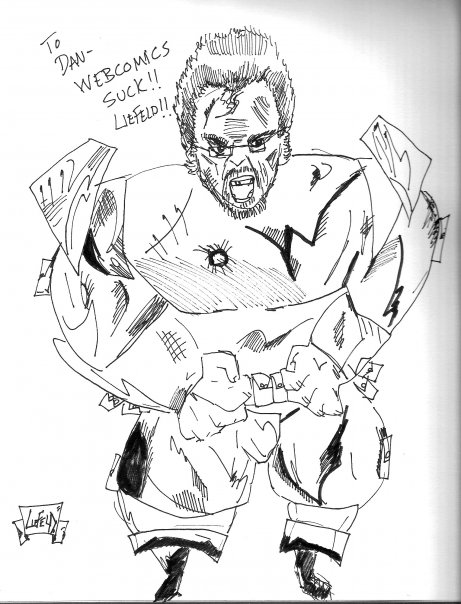
My favorite artist in the mainstream comics medium (meaning someone who draws for either Marvel or DC comics) is Greg Capullo, a fellow whose work I’ve followed since the mid-1990s when he started drawing the Marvel title, X-Force, shortly after series creator, Rob Liefeld, left. With his tenure he brought what can best be described as a weight to the characters––a roundness and believability that contrasted well with the bulked-up, heavy characters that Liefeld and his progeny always drew with a feathery loft. Despite all the hardware his characters wielded, nor the amount of veins that protruded from the arms, legs, necks, and faces of the characters, Liefeld’s kinetic style meant that his characters were almost never touching the ground. They were always mid-run or flying from the follow-through of a missed (or connected) punch. Liefeld drawings always look like beach balls in a racquetball court, which––in hindsight––focused the attention on him from the house style of the late 1970s. Things were moving his direction anyway, with the likes of Neal Adams, John Byrne, and Todd McFarlane, but Liefeld kicked the door in and invited all of his friends.

However, Greg Capullo brought––and pardon the pun––gravitas to Liefeld’s characters. Cable felt heavy and worn and tired. Cannonball actually felt explosive as he didn’t soar but blasted through the air. Capullo took over right before a major X-book crossover happened, my first crossover event called X-Cutioner’s Song (sigh), where Cable’s fuzzy origins come home to roost (and kill people). I remember being shocked by how different Capullo’s art was; it felt rounded and believable despite being very cartoony and stylized. When he left X-Force for Spawn at Image Comics, I started subscribing to that title in response.

Capullo is currently bringing his excessively popular run on the “New 52” Batman title to a close, drawing nigh fifty-one issues (he took a few issues off here and there), but he continues to prove that he’s a work horse that is not only competent but versatile and capable.

In an interview Capullo did in the last few years, he talked about one of the major hurdles he has had to overcome to become as good and versatile and capable as he is. He referenced, as evidence, a rejection he got from an editor at Marvel Comics early in his career. This editor said that Capullo was drawing symbols. What he saw on the pages were not eyes, but symbols of eyes, a rote memorization of what eyes can look like from that angle that can be applied anywhere. They weren’t real eyes. The same went for mouths or hands or faces or body types. With that advice (and the guidance of his art bible, Drawing from the Right Side of the Brain), he overcame that and it shows in his continued popularity (especially when put up from other artists who were on top in the 1990s).

This shows the main difference between an artist like Capullo and Rob Liefeld. I would never throw Liefeld under the bus as he has enough of that from plenty of people on the internet (to whom I will not link), but he is an artist who draws in symbols. His compositions are piecemeal and representative of the possibilities of what we can create in our own imaginations, the artistic equivalent of evocative prose. People attack him because they perceive a lack of ability, especially when he was in his early to mid-twenties and on top of the world. I would argue that while he has become more sensitive to those criticisms, his art hasn’t progressed beyond where it was back then, nor should it. He is a specific kind of artist. He is a fan gone pro, enthusiasm personified and can never––even with all available critical weight from the culture––waver.

For me––and I’m not claiming superiority; between Rob Liefeld and myself, one of us has a hit movie based on a character we created and the other does not (which is not the only evidence; I would argue he’s also a competent inker which I cannot claim)––what this means is that Liefeld is relatively easy to ape, especially for fun.

An old friend, Chris Linendoll, celebrated a birthday recently. Years ago, he drew as subpar Liefeld impression for one of my birthdays. Finally, it felt like time to reciprocate, and I was surprised at how well I did (in such a short amount of time).
A birthday present from Chris. Thanks, buddy.

A birthday present from Chris. Thanks, buddy.

What this tells me is that I know the symbols of comic art––a wider swath, perhaps, than Liefeld, but certainly not more successful at using them than he––and using them as tools is tiring. It’s boring and expected and, most importantly, not fun. The drawing above is not a good drawing, but it is evocative and accurate for what I was trying to evoke, which is the comfort (and joy) I pull from it. The pouches, the misaligned knife, the strange jumping pose, the swollen biceps. It’s kind of like putting together pieces of a puzzle, which is an apt description of any creative act; the trick comes when you want to create the pieces. I know for my own satisfaction that I need to push past drawing symbols and rest in the stress and anxiety and payoff that comes with making sure that every eye, face, hand, and leg I draw are more than just appropriate, but right.

 Comment 

Artist Workspaces

Mar08
by DBethel on 8 March 2016

A few months ago, I shared my workspace and wrote about it a bit. In that post, I focused on how the room and its artist are reflections of the other. This is probably true of any workspace, not just an artistic one, but I feel a workspace and its occupant are actually more inverted reflections of the other, a The Picture of Dorian Gray situation where the more messy the workspace is, the more focused and organized the occupant is and vice versa. My students often agree that whenever a paper needed to be written, my office was the cleanest it had ever been; inversely, whenever I am “in the zone,” so to speak, my office is piled with reference books, pens and pencils, headphones on the floor with other assorted cables, multiple empty coffee mugs dotting the space, all lightly misted with eraser dust.

Where I do my stuff.

From when I’m obviously an emotional wreck.

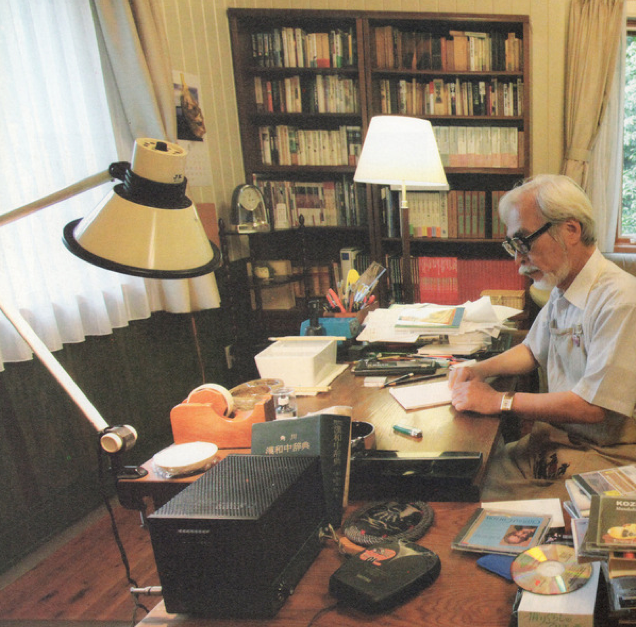
Seeing the workspaces of others is a fascinating, albeit voyeuristic, hobby. There are blogs on Tumblr that are devoted to showing the offices of writers and artists and seeing how different creative people can be calms the creative doubt quite a bit.

Hayao Miyazaki doing something smart, I'm sure. Source: Kotaku and Livedoor

Hayao Miyazaki doing something smart, I’m sure. Source: Kotaku and Livedoor

Recently, on the gaming/nerd culture website, Kotaku, published a photo set of working, popular manga artists that––I would argue––puts most workspaces to shame (or glory, depending on your outlook). At the very least, it makes me kind of wish my office were a mess right now. I should go work on that.

 Comment 

Sketch Fridays #19 – Bishop

Feb26
by DBethel on 26 February 2016
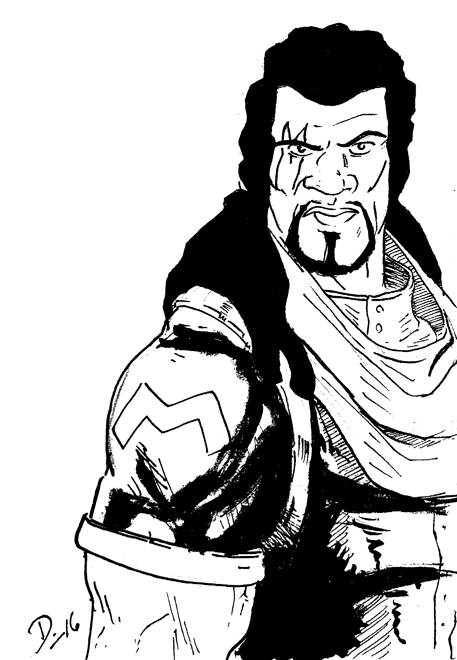
Sketch Fridays #19 - Bishop. Click for larger version.

Sketch Fridays #19 – Bishop. Click for larger version.

I’ve been thinking a lot about representation in comics recently, which wasn’t helped by the announcement of Finn Jones being cast in the role of Danny Rand in the upcoming Marvel Netflix series, Iron Fist––a story from the 1970s about a blue-eyed American kid who went with his family to a magical Asian village in the Oriental mountains and was trained in martial arts, only to return to America, see the level of crime rampant in his home country, and donned the mantle of the Iron Fist––Marvel’s pastiche of the popular-at-the-time kung fu movie craze.

Of course, it’s been forty years since that comic debuted, and as time progressed––along with social values and the announcement that Marvel was developing an Iron Fist Netflix show after the runaway hits of Daredevil and Jessica Jones––discussion surfaced about casting a more culturally appropriate actor for this show, which I don’t necessarily disagree with.

It’s a worthy discussion, but one I don’t have answers to, though I’m very eager to eavesdrop on its progression. But it made me think of characters that I came across before I became aware of the talk of diversity and tokenship. I was woefully ignorant, which has both positives and negatives––fully aware of my position of privilege as a straight, white male.

I got into comics fairly young––at 11 years old––with my purchase of X-Men #1. It was a year or so of severe change among the X franchise that saw new titles (with X-Men and X-Force being specific among them) and was charmed not by the obvious diversity among the cast, but by the ubiquitous sentiment shared by all of the characters––outcasts dealing with subjugation from “greater” society, ridicule and immediate judgment based on how they looked and what they were but, over which, they had no control. The diversity was simply assumed and immediately accepted.

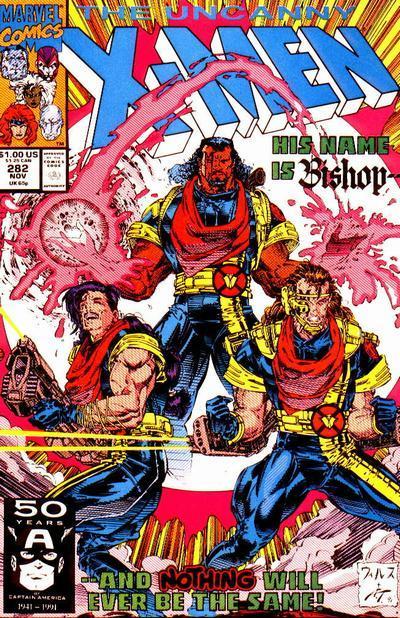
With the introduction of X-Men #1, there was a consequent “reboot” in Uncanny X-Men (the original publication) #280 that, after two issues, introduced a new black character into the regular roster––Bishop––a mutant from the future hellbent on finding the bastard that sold the X-Men out and ruined the future, basically. He had it out for the cajun Gambit, and was as ornery and confrontational as the amnesiac (and Canadian) Wolverine (my favorite, whom I discussed earlier).

Bishop's First Appearance in Uncanny X-Men #282. Art by Whilce Portacio and Art Thibert.

Bishop’s First Appearance in Uncanny X-Men #282. Art by Whilce Portacio and Art Thibert.

I was a devout X-Men reader, meaning that I only read X-Men and nothing else (no Uncanny, no X-Force, no X-Factor, even). I am, in hindsight, ashamed of my myopia. Despite that narrow-mindedness, Bishop showed up in X-Men at some point and I quickly accepted that he wasn’t lame (or else why would he appear in X-Men?). His mutant power is interesting. He absorbs energy and redirects it in powerful blasts to some poor victim’s face. While the nuance wasn’t explored during the time I followed the book, at least we got a cool guy with a big gun that could also shoot blasts of energy from his hands.

But his superpower is wonderfully reactive and metaphorical. I think it represents the ultimate fictional, superhero expression of the loner or outcast––the pre-judged––dealt with society. No matter the race or predilection, for many our statement was not a point of view as much as a reaction, absorbing the world as it washed over us and presenting it back in a concentrated and, with hope, a constructive form.

Bishop as portayed in the 2014 film, X-Men: Days of Future Past, played by Omar Sy.

Bishop as portrayed in the 2014 film, X-Men: Days of Future Past, played by Omar Sy.

Though X-Men was my preferred comic at the time, there is no doubt that Uncanny X-Men was the more progressive book in a variety of ways. It’s a shame that Jim Lee––the Beatles of comic books in the early ’90s––went to the adjectiveless book, because he could have done even more for the medium had he stayed on Uncanny. At the very least, Bishop may have gotten more mainstream exposure and acceptance had Lee been behind the pencil (nothing against Whilce Portacio; he was a solid and talented road band against Lee’s rock star status, though). Bishop deserves it, being the perfect mutant for what I still believe is the perfect metaphor.

1 Comment
  • Page 92 of 111
  • « First
  • «
  • 90
  • 91
  • 92
  • 93
  • 94
  • »
  • Last »
  • Instagram
  • Facebook
  • YouTube
Privacy & Cookies: This site uses cookies. By continuing to use this website, you agree to their use.

To find out more, including how to control cookies, see here: Cookie Policy
  • Newest Comic
  • About
  • Archive
  • Links
  • Shop
  • YouTube

©2014-2025 D. Bethel | Powered by WordPress with ComicPress | Subscribe: RSS | Back to Top ↑