• Newest Comic
  • About
    • Synopsis
    • Characters
    • Author
    • F.A.Q.
  • Archive
    • Comic Archive
    • Blog Archive
  • Links
    • Press
    • Connect
    • D. Bethel’s Work
    • Contact
    • Friends of Long John
  • Shop
    • Online Store
    • E-Books
  • YouTube

Long John

Losing Every Thing Changes Everything

Sketch Fridays #59 – Hellrider Jackie #03

Apr12
by DBethel on 12 April 2019
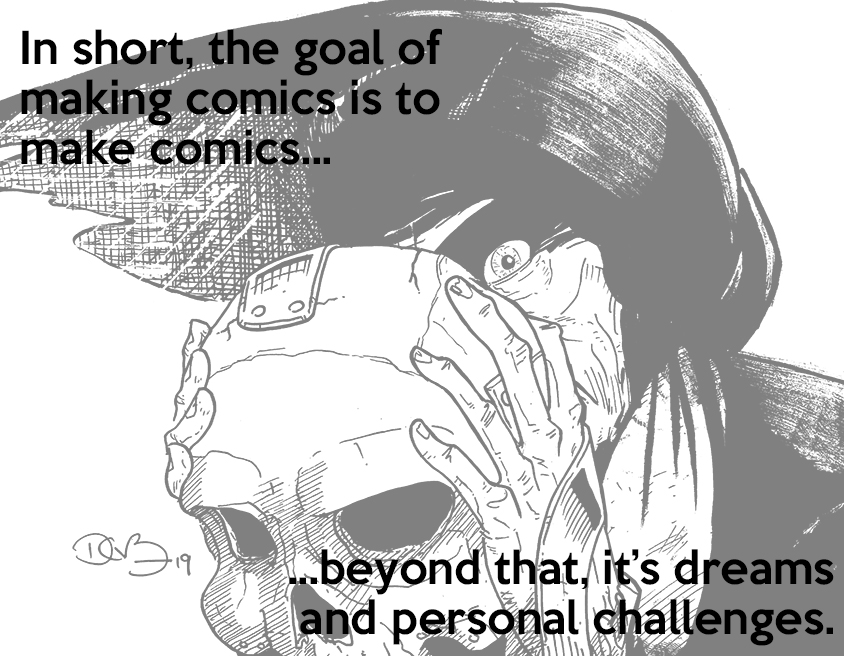
Sketch Friday #59 – Hellrider Jackie #03

Comicking is a solitary venture, even more so when as a dedicated hobby done in addition to a full-time day job. In that scenario, the time spent actually making comics is often abbreviated and sporadic, and the rest of your time is spent yearning for great blocks of uninterrupted productivity.

In short, the goal of making comics is to make comics. Beyond that, it’s dreams and personal challenges––the things meant to motivate you to get back to the table.

As an English teacher––albeit not a literature teacher––I have surely fantasized about teaching a critical analysis class about comics, but such a class was one of the last places I ever thought I’d find Long John as one among a list of required readings. However, I can proudly say that this semester Volume I was included in a CSU Sacramento upper-division English literature class led by Dr. Susan Fanetti.

Yes, she is a friend and, yes, I knew the class was being planned, but, no, I had no expectations nor assumptions about being a part of the curriculum. If I was invested in anything, it was merely to get the reading list to see what texts she assigned (side note: her reading list was much better than any I had generated during my thought experiments).

Alone,Long John‘s inclusion was incredibly validating and humbling even if my self-deprecation reflex activated immediately, to the point where I ended my response to Fanetti’s initial offer with the parenthetical, “(Let’s hope Long John, vol. 1 offers something for the students to find!).”

And while having Volume I in a college-level class is in itself cause enough for personal victory, the peak extended even higher. As much as I never would have thought a book of mine would be included in a college literature class, I never thought I would be in a position to talk about comics to such a class either.

Dr. Fanetti asked if, after they had their class discussion about the book, I could come in to chat and answer any questions they may have after reading. I could also cover any aspects around the making of comics that may get overlooked by the general reader. That, to me, was the true nexus point in my dual (but unbalanced) careers, where pedagogy and comicking become one thing.

I agonized over preparing the talk, putting an undue and unfair amount of weight on its success––as if I faced expulsion from both teaching and comicking if things went poorly. Also burdening my anxiety was the wonder of how to talk to a room of literature students, something I don’t do during the normal course of my workday.

To that end, I stressed over all of the possible flaws of plot and continuity for which I could be derided and the book ridiculed as incomprehensible nonsense, or how I possibly and unknowingly worked in something so offensive that I would be met at the door with pitchforks and lawsuits.

However, for all the preparatory fuss, I gave the talk and it went as planned, which is the best outcome for any public speaking, I would say. My mouth went dry in the middle and, toward the end, I started my usual anxiety-driven stutter. But when I nailed the ending, I stepped back feeling as accomplished as I had hoped.

And then the floor was opened up for questions.

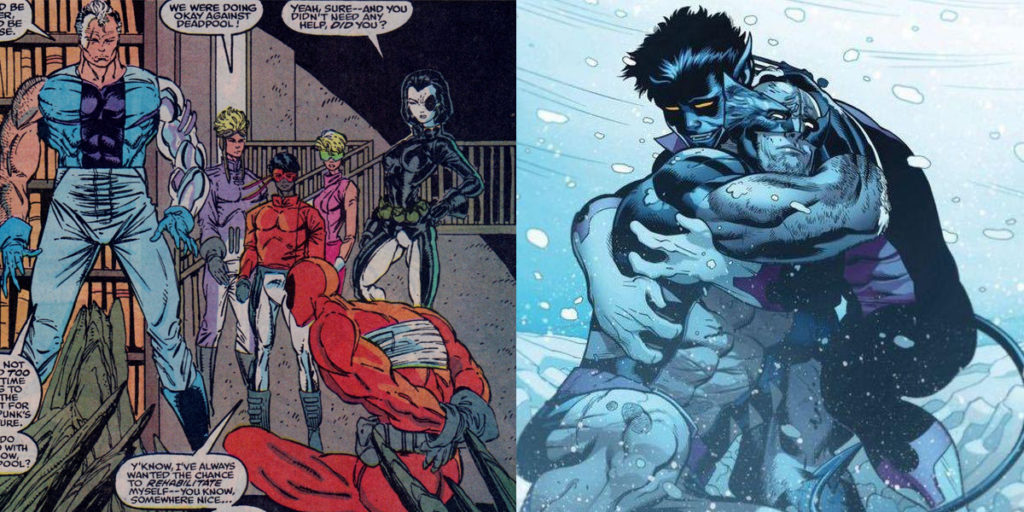
Two slides I used in my talk to illustrate the importance of interaction of characters with each other and with their setting and how understanding this can help sell the emotional narrative of a story more than words or individual poses. Art by Rob Liefeld (pencils/inks) and Steve Buccellato (colors) (left, from New Mutants #98), and Ed McGuinness (p), Dexter Vines (i), and Marte Gracia (c) (right, from Amazing X-Men #4) Image source: Marvel Comics.

I’ve been asked a lot of questions at shows and on podcast interviews, but they tend to run around the same tracks––asking about tools, artistic inspiration, and if I’d draw their comic. These students, however, offered questions. They thoughtfully probed the characters and aesthetics, yielding powerful insights which showed me what people were taking from the book when walking into it blind (why did I color the lake on the cover for “Save the Bones” red when, at the start of “Sunza”, I colored it black?). It was this discourse that ended up being the greatest reward from this experience, and it wasn’t anything I concocted or machinated; it was simply through being one half of a conversation about comics.

All of that for this: what inspired this week’s drawing was another surprising aspect of the talk––the students really liked and responded to Hellrider Jackie. In fact, most of the conversation and questions focused around her, which comforted me with the knowledge that I could make a character who barely appears in the story (so far) have a profound impact on the reader (something I tried to do again––in a different way––with Juan John in Chapter 3, “Making Smoke”).

I can’t thank Dr. Fanetti or her students enough, and I hope they read this and take my comments to heart: they gave this comicker a lot of confidence, validation, and motivation to keep trying to do what I’ve been doing––making my weird little character-driven western as best I can. In the long run, few other experiences will exceed the fear, excitement, and reward than the first time I walked into a room of readers armed with honest critical approaches to my work and trust-fell into their analysis.

2 Comments

D. Bethel Draws… Hellboy

Apr05
by DBethel on 5 April 2019

The day job has been quite taxing and busy this week; so, in lieu of a Sketch Friday I did have time to put together a video of me inking last week’s entry. Unlike previous “D. Bethel Draws…” videos––which were just sped-up videos over music––I tried something new at the behest of local comics compatriot, Kyrun Silva.

While music is still there (and I think I’ll go back in and adjust the levels a bit or remove most of the music entirely), I added commentary over the top where, in this case, I talk about my association with Hellboy and inking with a brush. Please check it––and the other videos on my YouTube channel––out and let me know what you think!

Stay tuned for interesting stuff coming down the pike!

1 Comment

Sketch Fridays #58 – Hellboy

Mar29
by DBethel on 29 March 2019
Sketch Friday #58 – Hellboy

In my teens, the art of Mike Mignola was a hard sell for me. Admittedly, I categorized him as one of the “weird” artists––where Mignola was joined by the likes of Jae Lee, Brian Stelfreeze, Sam Kieth,Larry Stroman, Bill Sienkiewicz, and Dave McKean––that is, artists who didn’t follow the norm of Jim Lee-styled superheroics and, as a result, were rebuffed of my attention.

However, Mignola stands out from those other artists in that I came around to his style earlier than many of the others. Though he didn’t draw in the highly-rendered hyper-realistic style of the Jim Lee school of comic art, his blocky, high-contrast approach to covers and interiors retained the heightened melodrama that I enjoyed with more mainstream art.

Hellboy as drawn by Mike Mignola.

To that end, I did immediately respect Hellboy when it first appeared. Though I probably overestimated its value as I compared it to the more mainstream work of Marvel’s X-Men books and their Image Comics clones in WildC.A.T.s––so, I lumped Hellboy into the comics-as-art (to my teenage brain) pool populated by Concrete, Love and Rockets, Cerebus, and even Bone (admittedly, my scope on the medium was rather myopic as a youth).

Probably my earliest exposure to Mignola, his cover work on the X-Men Classic reprint books.

Now, I find myself following the abstracted leads of art like Mignola, drawing from their stylized compositions to find new and interesting ways to present not only my own characters, but my art in general. It’s due, in part, to Mignola’s work that Long John volumes 1 & 2’s covers are the way they are. If not a direct inspiration, learning to respect the work of Mignola and his “weird” kin really opened my eyes to the possibility of comic art and finding inspiration beyond those whom I simply wanted to emulate or aspire to. In fact, following these esoteric trails pushed me to change my goals and find new, personalized, and unique paths to travel down.

After struggling to find mainstream work in the early nineties––he hit some high notes with things like World of Krypton and Gotham By Gaslight for DC Comics as well as drawing the Rocket Raccoon limited series and a lot of cover work for Marvel––he found a home with Dark Horse Comics that gave him the platform to literally make a comic about whatever he wanted. As noted in many interviews, he said that he knew he liked to draw monsters and so he created a book that allowed him to do just that (which also shows why he and Guillermo del Toro got along so well).

Twenty-five years later, Hellboy is probably the most well-known independent comic book creation in popular culture. So, a victory for Mignola and Hellboy is a victory for all independent creators.

Lineart of this week’s Sketch Friday.
1 Comment
  • Page 56 of 111
  • « First
  • «
  • 54
  • 55
  • 56
  • 57
  • 58
  • »
  • Last »
  • Instagram
  • Facebook
  • YouTube
Privacy & Cookies: This site uses cookies. By continuing to use this website, you agree to their use.

To find out more, including how to control cookies, see here: Cookie Policy
  • Newest Comic
  • About
  • Archive
  • Links
  • Shop
  • YouTube

©2014-2025 D. Bethel | Powered by WordPress with ComicPress | Subscribe: RSS | Back to Top ↑