• Newest Comic
  • About
    • Synopsis
    • Characters
    • Author
    • F.A.Q.
  • Archive
    • Comic Archive
    • Blog Archive
  • Links
    • Press
    • Connect
    • D. Bethel’s Work
    • Contact
    • Friends of Long John
  • Shop
    • Online Store
    • E-Books
  • YouTube

Long John

Losing Every Thing Changes Everything

Sketch Fridays #24 – After Darwyn Cooke

May20
by DBethel on 20 May 2016
Sketch Fridays #23 - Darwyn Cooke

Sketch Fridays #24 – After Darwyn Cooke

For any creative, new expressions are the sum of their influences. We are all products of such algorithms, asserting our independence while hoping the seams don’t show. The tautology of this tendency is hilarious: you can’t show your influences unless you have influences.

There is a strong, post-modern, self-aware streak coursing through popular culture as of late in films and video games and television shows, etc., all of which beg the audience to look at the very seams we work so hard to shelter from prying eyes. I think such turns come when we accept our confidence in our abilities and aren’t afraid of being called frauds anymore. Such confidence was on display in the successful superhero-parody, Deadpool, or recently in the Chip Zdarsky and Joe Quinones reboot of Marvel Comics’ Howard the Duck comic series. They beg the audience to draw the lines between inspiration and the inspired, they’re proud of it and flaunt it.

In a subdued way, artist Darwyn Cooke was the same, but without much pretense. Cooke was an artist that most people in my age group have encountered despite his name never being forward-presenting. He was a freelance storyboard artist on Batman: The Animated Series, and, later, handmade (with the help of computers) the very stylish opening credits to the highly regarded animated series, Batman Beyond (as well as a stellar short in celebration of Batman’s 75th anniversary). He redesigned Catwoman back to her cat burglar roots in the early 2000s (and made her outfits a bit more practical and, at the very least, stylish). Cooke also made the Silver Age of DC Comics cool again with his hugely influential graphic novel, Justice League: New Frontier.

Darwyn Cooke's Justice League: New Frontier

Darwyn Cooke’s Justice League: New Frontier

For me, his series of graphic novel adaptations of the Richard Stark (a pseudonym for novelist Donald Westlake) gangster revenge series of books featuring the singularly-named Parker played a huge part in my developing style, especially for Long John. Some may be familiar with filmic adaptations of the first book in this series––The Hunter––in 1967’s Lee Marvin vehicle, Point Blank, or the 1999 Mel Gibson vehicle, Payback. With such a diverse catalogue, it’s clear that Cooke was less interested in showing off how good he was at making the old new again as he was in telling a story in the best way possible, no matter the medium.

Cooke’s influences were clear but he wasn’t a mere retro stylist who reveled in the tropes and irony of doing such a thing (Quentin Tarantino dances dangerously close to this line). Instead, he was a creative that kept his head down and used his highly unique and comfortable style to draw the audience in through its embedded nostalgia while delivering a well-crafted and modern story on top of that.

Cooke's work from Parker: The Slayground.

Cooke’s work from Parker: Slayground.

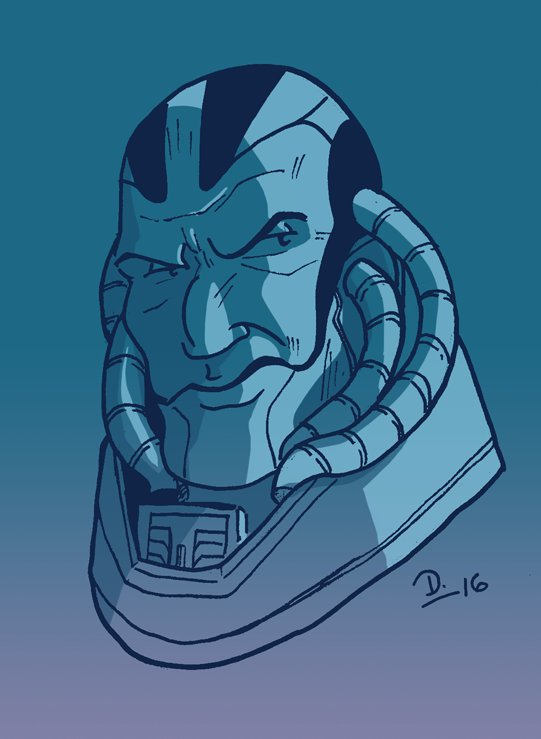
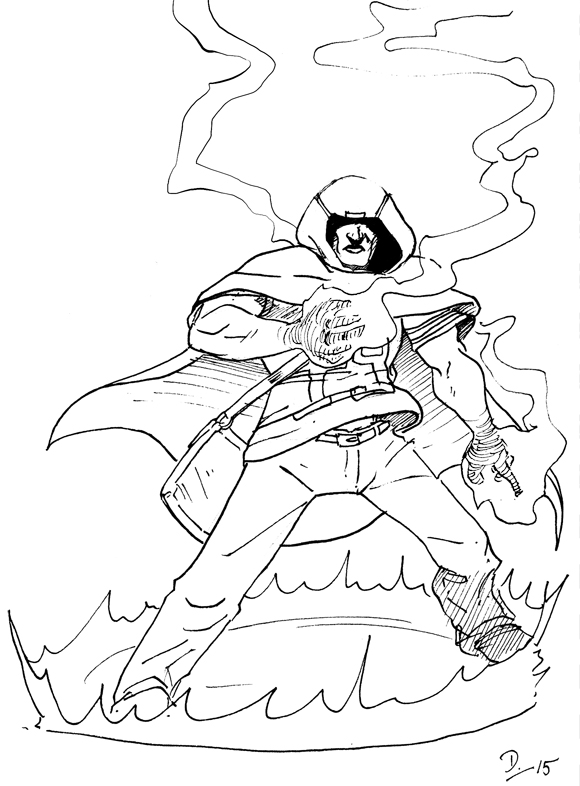
When I learned that Cooke died on the 14th, the news deeply saddened me, more than I expected. I wanted to write this much earlier, but I had trouble finding an angle that was more than just pathos or navel-gazing. With that, I still have only crafted what dozens of people have already done online by fashioning a superficial retrospective. The best I have to say is in the drawing at the top where I attempted to draw Long John in Cooke’s style. The result made me laugh because it’s actually not too different from how I normally draw him, which speaks much more loudly than any word I have written here.

I have never been quiet about his influence on Long John––in everything from the sharp jaws of the character design to the Parker-influenced coloring I landed on––but I hadn’t realized how important his work was to me until he died, which is the saddest part. His work was more than just a seam that kept my art together, but also a pattern on which I have cut my cloth.

1 Comment

Sketch Fridays #23 – Lead By Example

May06
by DBethel on 6 May 2016
Sketch Fridays #23 - Lead By Example. Click to Enlarge.

Sketch Fridays #23 – Lead By Example. Click to Enlarge.

Perhaps it’s because I’m boring or secluded or one that always tries to please, but when it comes to nerdy fiction I’ve always been drawn to the leader characters. Cyclops from the X-Men. Leonardo from the Ninja Turtles. Cecil from Final Fantasy IV. The Fighter from Final Fantasy. While many people write off these characters as bland, uninteresting, sophomoric, or––worst yet––assholes, I often found a sense of contemplative calm instead.

I’ll be honest, I liked Leonardo best because he had swords––the most visibly dangerous of the weapons the Brothers Turtle had available. I am also a big fan of the color blue, which also worked in his favor. But my predilection toward him really came home in the 1990 film, Teenage Mutant Ninja Turtles, a mighty fine cinematic (the best, I dare say) treatment of the venerated yet mercurial franchise. When his brother is nearly mortally wounded, Leonardo stops all retentive nit-picking to focus on monitoring and caring for the ill Raphael (who does so comatose in a rural bathtub). Leo sits in a chair, day and night, waiting for any response, and is the first person there when Raph awakens. Furthermore, Leonardo acts as the bridge between practical realism and the old world spirituality in which the brothers’ shared ninjitsu rests. When the brothers are recovering and training in response to the kidnapping of their father (the wise old rat, Splinter), it is Leonardo that establishes an astral connection with his own adopted father through practiced meditation. Instead of trying to whittle answers from his father––to receive some personalized sage advice as his father surely counts down the moments to his horrendous and violent fate––Leonardo retrieves his three brothers so they can share the responsibility.

As an only child, my friends become my family, and those I call friends are those that are very close to me. If anything, Leonardo’s behavior––again, mostly in the 1990 film––gave me a template for brotherhood that I could lay over any consequent life I lead. Despite being a nearly-naked turtle, from Leonardo I absorbed the idealistic values that constitute a huge part of who I am today. Glory is dust in the light. Leadership is a light in the darkness: alone, focused, and guiding.

In contrast, I resisted the X-Men’s Cyclops (aka Scott Summers) for years, perhaps decades. As stated before, I am a fan of Wolverine. I connected with the latter if only because of my own fiery temper but also in my one-quarter Canadian blood. But I always respected Cyclops greatly (from the stories to which I was exposed, which was not an exhaustive retrospective). I respected the inherent tragedy of the character. As a boy, he suffered a head-trauma that left him not only a kid with the mutant power to shoot force beams out of his eyes, but also with brain damage that disengaged his ability to control said blasts. The only thing that was found to keep the eye-beams at bay (aside from Scott Summers’ own closed eyelids) were lenses made from ruby quartz. So, until the day he dies, he can only see the world through ruby (i.e., rose) colored glasses. Everything will forever be tinted crimson and, even though he has been afforded the ability to see (otherwise, he’d have to wander through life with his eyes shut), he has to accept that he will not be able to gaze upon the things which or those whom he loves without a filter between them, lest he mortally wounds them due to his uncontrollable gift.

In response, Scott has become the quintessential X-Man––a boy scout, a flag-waving poster child for Xavier’s School for the Gifted––which, in his consequential blandness and devotion leaves him as either antagonist or plain background to the more colorful characters that populate the mansion. He overcorrects, for sure, but he does son in response to the life-debilitating deficit of which only he knows the fullest extent. But he demands no attention nor validation; instead, he only asks for respect when the klaxon sounds and the X-Men are needed to solve a problem. Otherwise, as you were.

Part of me wonders if my reconnection with these characters recently is a response to me becoming a teacher––a person who must (in a very focused way) lead groups of people. In that sense, I do find myself idealistically devoted to the principles of the class I am teaching, like Leonardo balancing his practical leadership with his ancient mystical lore. I also find myself sympathizing with Cyclops, himself a teacher, and wondering how to balance the genuine interest I have in every single student with the job I must accomplish. As much as I want to be a friend, I must first––and foremost––be an example.

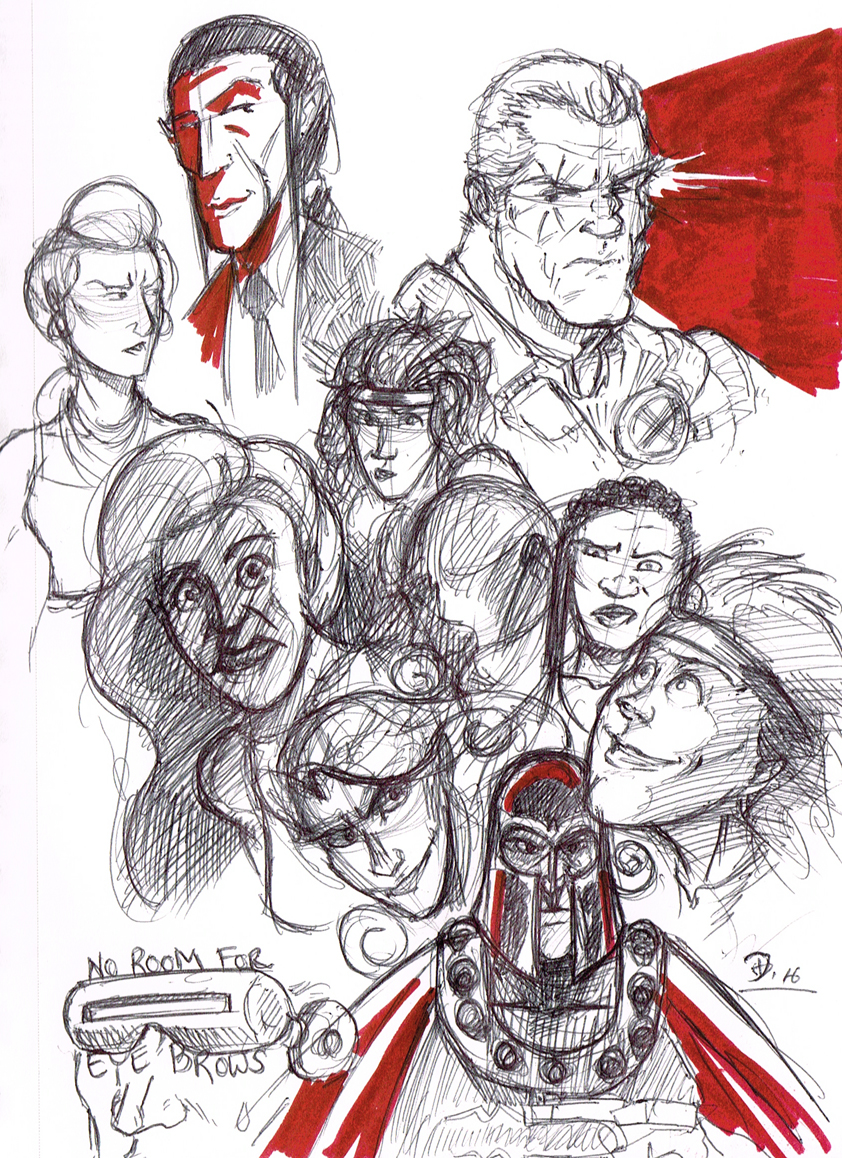
So, I wondered what would happen if I facilitated a crossover––what if the boring, boy scout hero from one franchise met up with the equivalent from another? I bandied about with possible action drawings of Cyclops letting loose his optic blasts as Leonardo leaps into the fray with both swords drawn. But that felt easy and nondescript. What would really happen if these two stoics met up? What would actually occur? I figured they would plan. They would be planning the night before. So, I gave them a rooftop and let them talk, and I’m sure I may be one of the few that is quite interested in what they’re saying to each other.

1 Comment

The New Magnificent Seven

Apr28
by DBethel on 28 April 2016

For vocational legitimacy, I do feel a strange obligation to keep up-to-date with any westerns that broach the popular market. Films like Bone Tomahawk and Jane’s Got a Gun escaped my viewing (though not my notice), and I have heard good things about both original entries into the genre.

One that kind of blindsided me was an apparent re-make of The Magnificent Seven, originally a 1960 film directed by John Sturges and starring Lee Marvin and Steve McQueen (and Eli Wallach and Yul Brynner).  I’m sure I had heard about the remake at some point, but I dismissed it because, it seems, every cultural tentpole seems to have an announced remake in the works (I’m surprised that a Bullitt remake hasn’t been announced). But an official teaser trailer––or as I like to call it, a trailer, because semantics are exhausting––has been dropped on us that convincingly declares that this remake that is indeed happening.

I must disclose that, in the case of movies, I am not a curmudgeon. Though I have movies that mean a lot to me, I don’t hold them sacred. A remake doesn’t, through some weird retroactive cultural osmosis, “ruin” the original or, at the very least, compromise it. Don’t forget that I am a Transformers fan, and I accept that there exists the Michael Bay movies alongside the original cartoons that I love so much. One has not been erased nor invalidated by the more recent entries (though the definition of Transformers may be changing, which disheartens me). There are the movies as well as the cartoons, and I live happily in the in-between. Such is the case with any adaptation. Especially as a person who identifies as a nerdy individual, I have grown tired of pre-judging––and post-judging––media which has been adapted from previous iterations or other media.

Truth be told, I haven’t seen the original The Magnificent Seven. Perhaps that’s a sin from a guy who is making a western comic. Part of what mediates, perhaps, my aghast heresy of this trailer is that I am quite familiar with the film The Magnificent Seven was adapted from, Akira Kurosawa’s Seven Samurai from 1954. Similarly, my declared and subjective “favorite film of all time” is Akira Kurosawa’s Yojimbo, which was, of course, adapted (illegally, as it turns out) into Sergio Leone’s A Fistful of Dollars. So, I hold no particular awe nor reverence toward the John Sturges film if only because I have seen the original it was adapted from. Perspective is a key ingredient in the consumption of popular culture and it took me awhile to realize it.

What I do like about the trailer is that it adheres to the spirit of Seven Samurai (which, if you have about three hours to kill, give it a shot––it holds up pretty well for being a black and white samurai film in Japanese) in that the seven are very diverse in terms of character, speciality, and focus. In a way, it feels a little bit like a cartoon or video game where there is no overlap between characters; each one fills a narrative or, at the very least, thematic need as well as having something cool and unique about them. Surely, by the time this movie is released we’ll be talking about the “machine gun guy” or the “indian guy” or the “upstart kid” or the “moral high-ground leader.” It’s what made that original Japanese movie so important in addition to being what makes it most outdated in a modern setting. I’m not saying that it created that idea where each character not only has a unique thematic purpose but also has a unique, marketable quality (in terms of merchandising; a bad but equitable example of this can be seen in the historically atrocious film, King Arthur, led by Clive Owen and Keira Knightley, not that King Arthur has any historical validity in the first place, but still), that makes the group seem less like a gathering of inscrutable gunslingers and more like the Teenage Mutant Ninja Turtles. There is no doubt that Seven Samurai is, at least, an early example of it.

A drawing I did while re-watching Seven Samurai back in '01 or '02, based on the moral high-ground leader of the group.

A drawing I did while re-watching Seven Samurai back in ’01 or ’02, based on the character, Kambei Shimada, the moral high-ground leader of the group.

No matter what, I’m intrigued. I like Denzel Washington and Chris Pratt and I would like to see them both in a western. Lucky for me, they get to be in the same one––it’s like Silverado all over again. I also like––or would like to like––a number of the other cast in the movie. However, it is a story we’ve seen before, whether in the original context or the dozens of interpretations and dilutions we’ve seen since then. And this will just be another one of them, for better or for worse. At the very least––and this is increasingly become the most important criterion for my movie-going experience––it looks fun.

 Comment 
  • Page 90 of 111
  • « First
  • «
  • 88
  • 89
  • 90
  • 91
  • 92
  • »
  • Last »
  • Instagram
  • Facebook
  • YouTube
Privacy & Cookies: This site uses cookies. By continuing to use this website, you agree to their use.

To find out more, including how to control cookies, see here: Cookie Policy
  • Newest Comic
  • About
  • Archive
  • Links
  • Shop
  • YouTube

©2014-2025 D. Bethel | Powered by WordPress with ComicPress | Subscribe: RSS | Back to Top ↑